Budget scenarios
A scenario runs Meridian's
BudgetOptimizer
on a fitted model: how to split a budget across the channels, within bounds. New scenario writes
scenarios/<name>.yaml on a model:
name: plus-10
model: synthetic-v1                  # models/synthetic-v1.yaml, fitted first
# window: { start: 2024-01-01, end: 2024-12-30 }   the period whose spend is reallocated; default the whole fit
budget: +10%                         # historical, an amount, or a change like +10%
bounds: { lower: 0.3, upper: 0.3 }   # how far a channel may move from its historical spend, as a fraction
channels:                            # per-channel bounds, overriding bounds
  ch0: { lower: 0.1, upper: 0.5 }
Budget, or a target
budget:historicalkeeps the window's spend; a number is an amount;+10%or-5%moves from the historical spend.targetinstead lets the budget float until it is met:{ roi: 2.0 }, the total ROI to reach, or{ mroi: 1.5 }, the marginal ROI below which nothing more is spent.budgetis then ignored.
Bounds
bounds says how far every channel may move from its historical spend, as fractions: { lower: 0.3, upper: 0.3 }
(Meridian's default) keeps each between 70% and 130% of what it spent. channels overrides them channel by
channel, by the names the dataset gives them.
Optimize
Click ▶ Optimize above the file, or on the scenario in the tree; it is also a task, which can
depend on the model's fit. It reloads the model's latest fit (model.binpb): the project's copy, or, when it is
gone (another machine, with a shared tracking server), MLflow's.
The results open beside the editor: the budget, outcome and ROI before and after, and each channel's spend, ROI and outcome before and after. Meridian's "before" is the historical mix scaled to the scenario's budget: the same money, split as before.
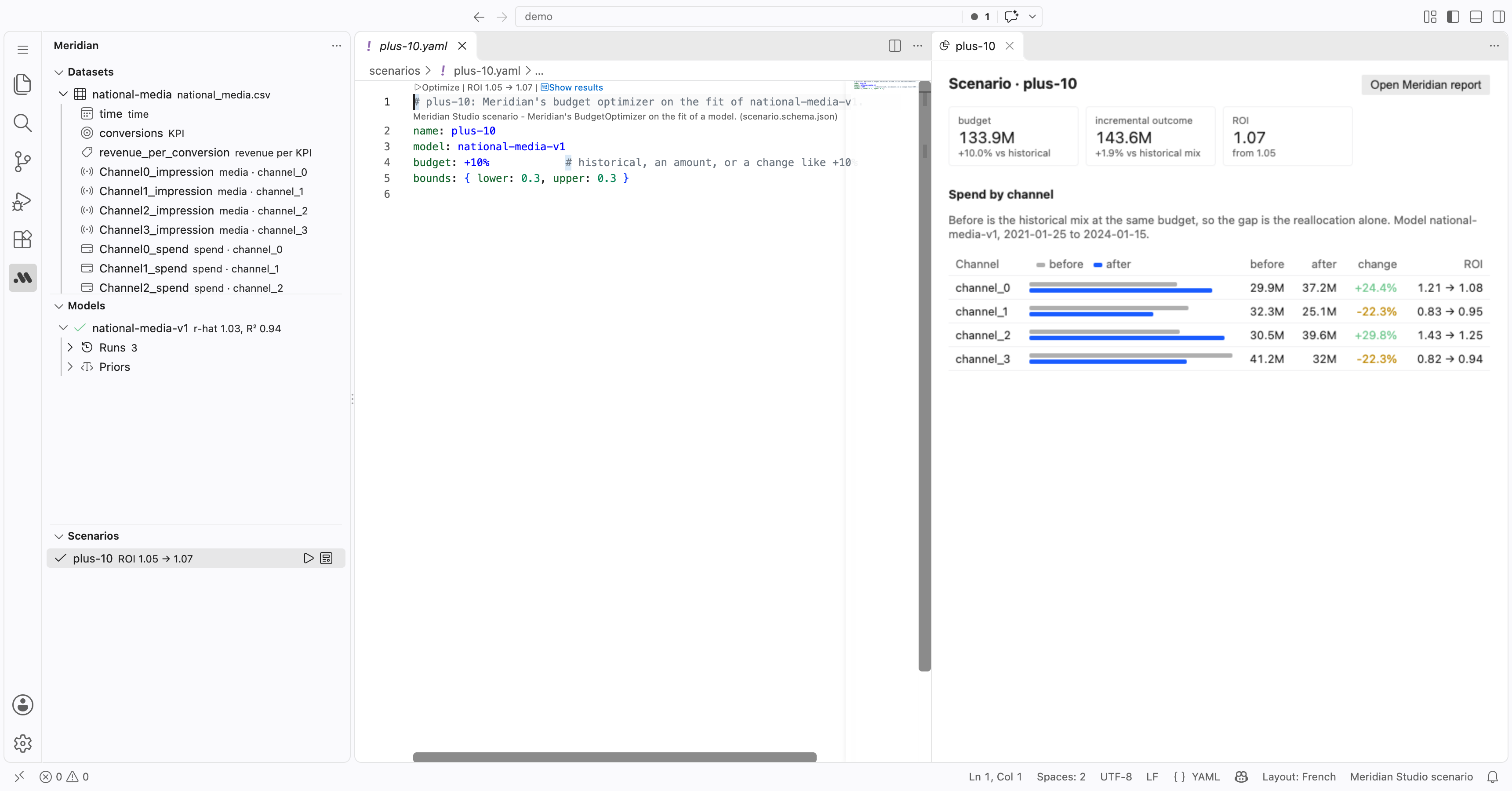
They are also in scenarios/<name>.result.json, with the fit they came from (its MLflow run), and Meridian's
optimization summary in scenarios/<name>.html.
Each optimization is an MLflow run, under its fit's run: the scenario as parameters (budget, bounds, channels,
target, window), the budget, outcome and ROI before and after as metrics, in total and by channel, and Meridian's
summary, the scenario's YAML and its result as artifacts. A scenario refused before it starts (a budget it cannot
read, say) makes no run. Open MLflow, on the scenario, opens it.